
Publications
Peer-Reviewed Work
The method behind SONDA has been developed and validated in the open literature, first at the University Medical Center Groningen and then with clinical partners across Europe.
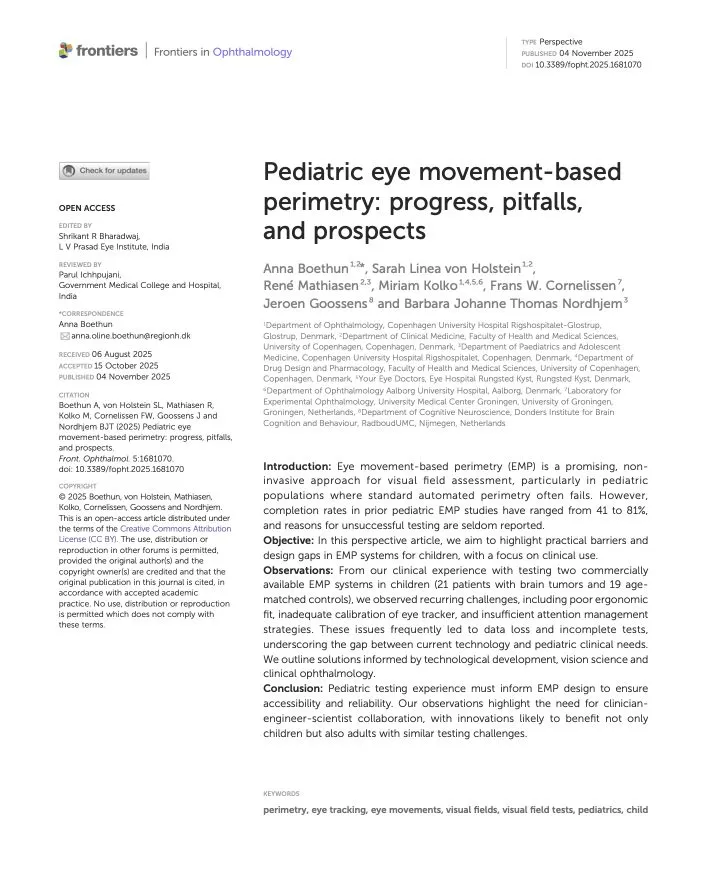
A clinical perspective from Rigshospitalet on what eye-movement perimetry must get right for children, ergonomics, calibration and attention, drawn from testing 21 paediatric brain-tumour patients and 19 controls on two commercial systems, SONDA among them.
Pediatric eye movement-based perimetry: progress, pitfalls, and prospects. Frontiers in Ophthalmology, 5:1681070.
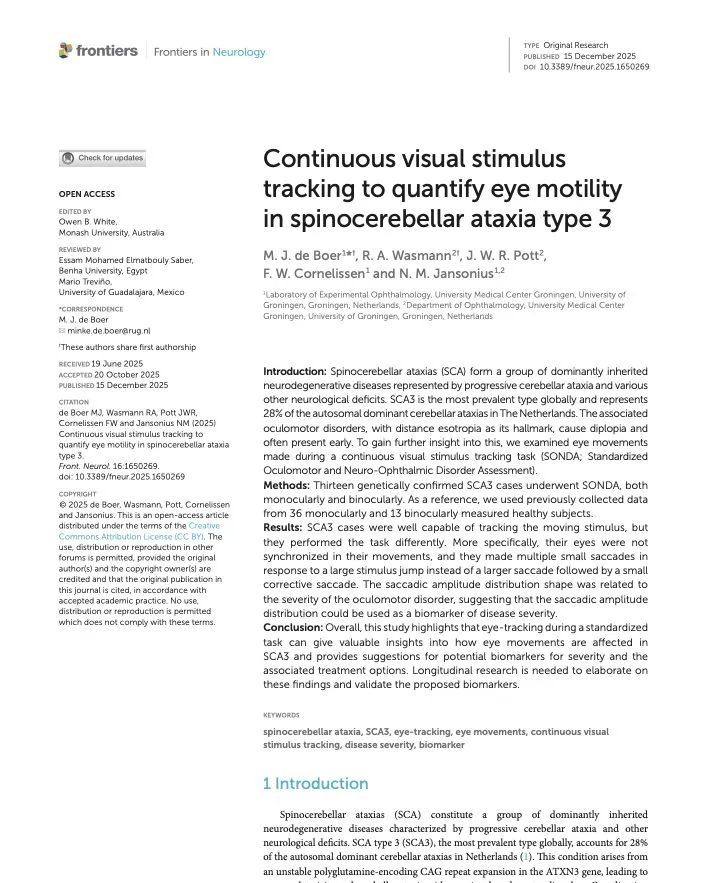
Read the paper: doi.org/10.3389/fopht.2025.1681070In spinocerebellar ataxia type 3, the shape of the saccadic amplitude distribution during SONDA tracked disease severity, a candidate biomarker that conventional saccade measures do not see.
Continuous visual stimulus tracking to quantify eye motility in spinocerebellar ataxia type 3. Frontiers in Neurology, 16:1650269.
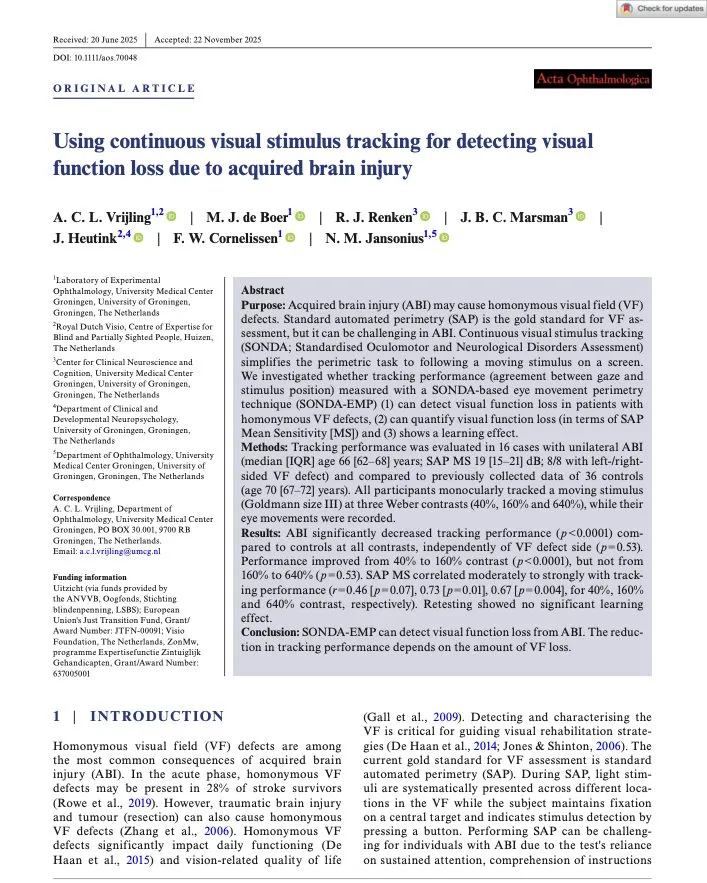
Read the paper: doi.org/10.3389/fneur.2025.1650269In acquired brain injury, SONDA detected homonymous visual field loss regardless of the affected side, correlated with perimetry (r = 0.73) and showed no learning effect, in exactly the patients for whom standard perimetry is least reliable.
Using continuous visual stimulus tracking for detecting visual function loss due to acquired brain injury. Acta Ophthalmologica.
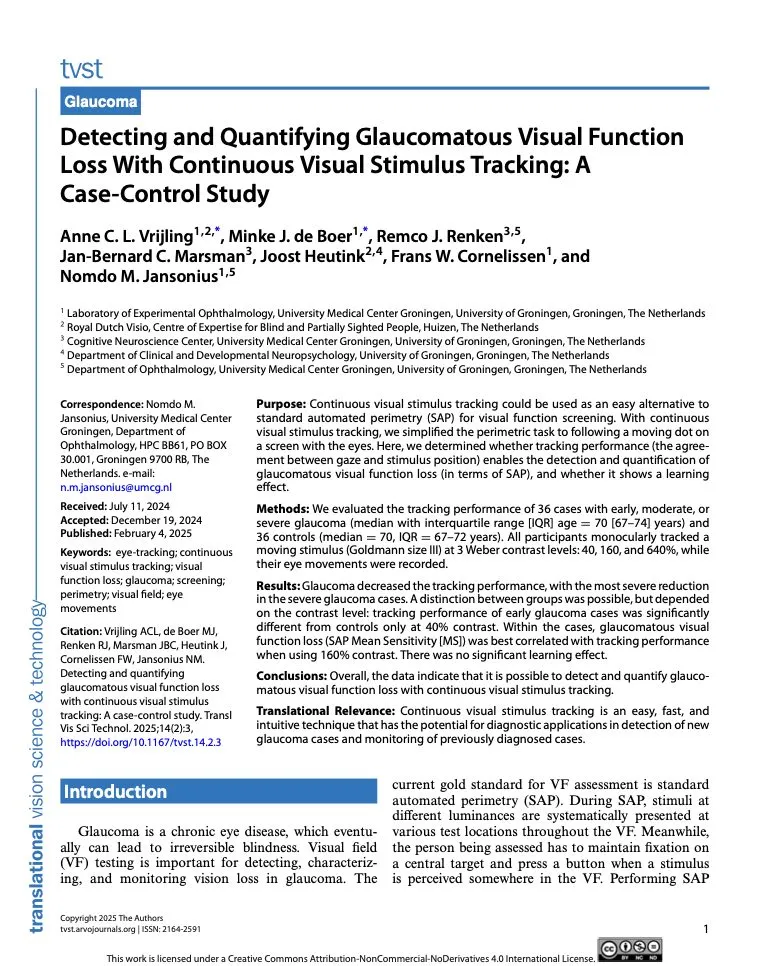
Read the paper: doi.org/10.1111/aos.70048Glaucoma reduces SONDA tracking performance in proportion to the visual field loss measured with Humphrey perimetry, across early, moderate and severe disease, with no learning effect between visits.
Detecting and quantifying glaucomatous visual function loss with continuous visual stimulus tracking: a case-control study. Translational Vision Science & Technology, 14(2):3.
Read the paper: doi.org/10.1167/tvst.14.2.3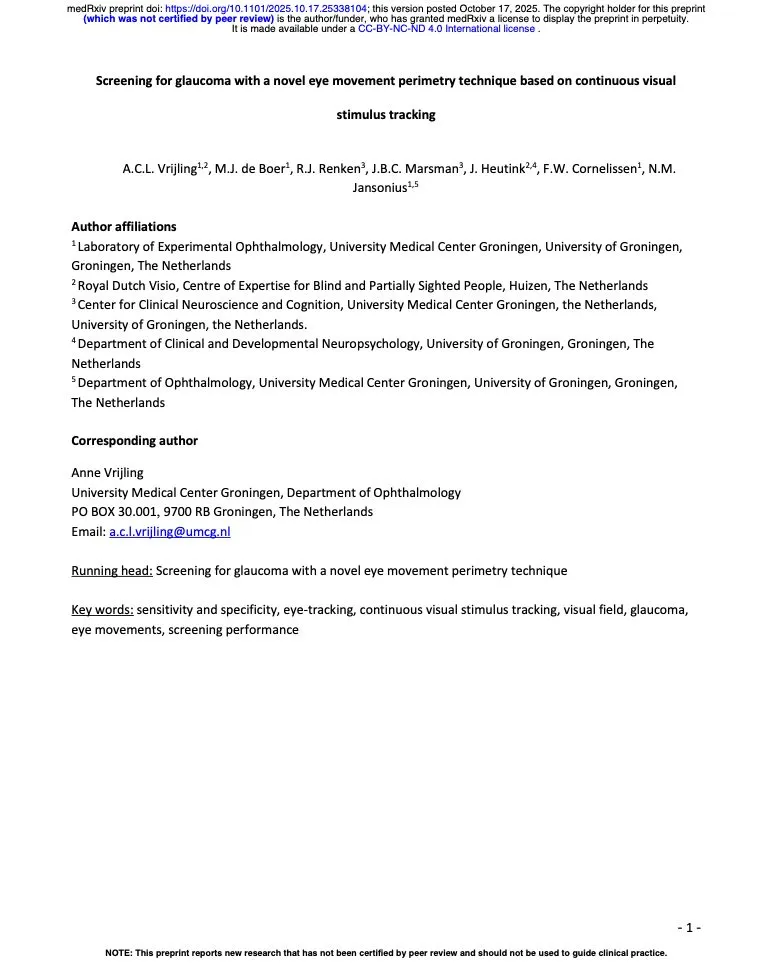
The pivotal clinical investigation of SONDA as a glaucoma screening tool, 100 patients and 100 age-matched controls: diagnostic accuracy across all severity stages, no learning effect, and patients rating the test easier and less tiring than standard automated perimetry.
Screening for glaucoma with a novel eye movement perimetry technique based on continuous visual stimulus tracking.
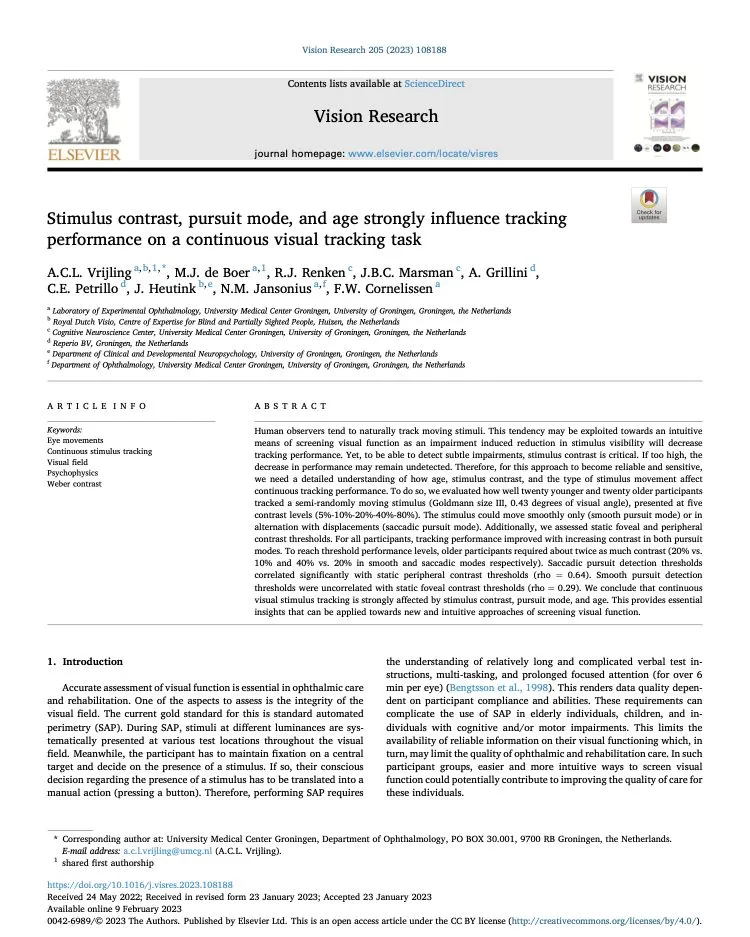
Preprint under peer review; link to follow on publication.Maps how stimulus contrast, pursuit mode and age shape tracking performance in healthy observers: the groundwork that lets SONDA detect subtle functional loss without false alarms.
Stimulus contrast, pursuit mode, and age strongly influence tracking performance on a continuous visual tracking task. Vision Research, 205:108188.
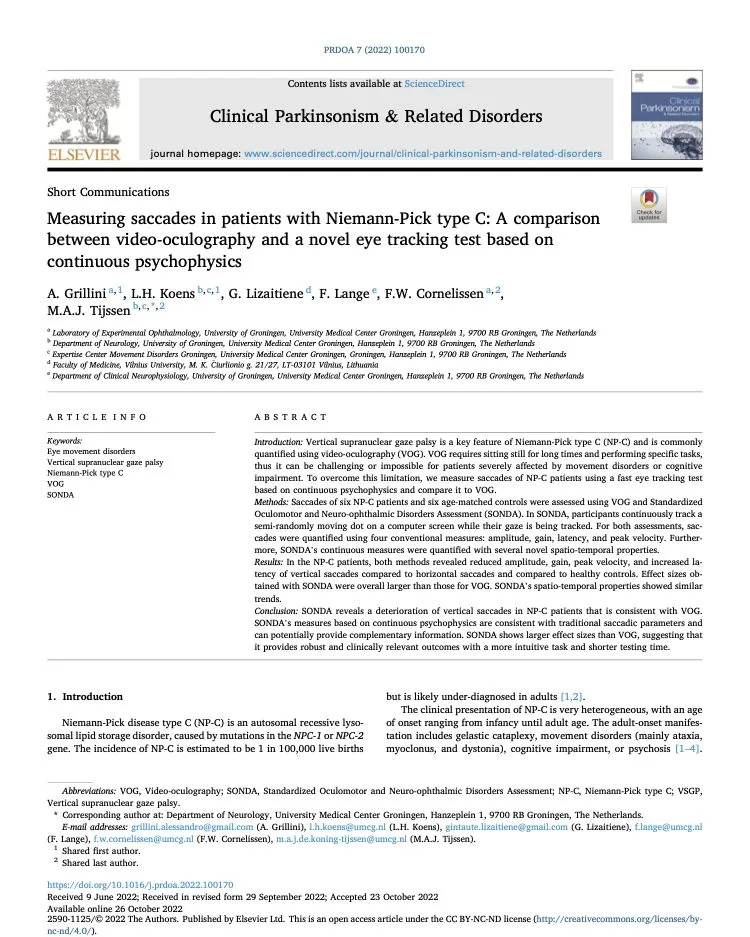
Read the paper: doi.org/10.1016/j.visres.2023.108188In Niemann-Pick type C, SONDA recovered the same vertical-saccade pathology as clinical video-oculography, with larger effect sizes, in under three minutes and without requiring stable fixation.
Measuring saccades in patients with Niemann-Pick type C: a comparison between video-oculography and a novel eye tracking test based on continuous psychophysics. Clinical Parkinsonism & Related Disorders, 7:100170.
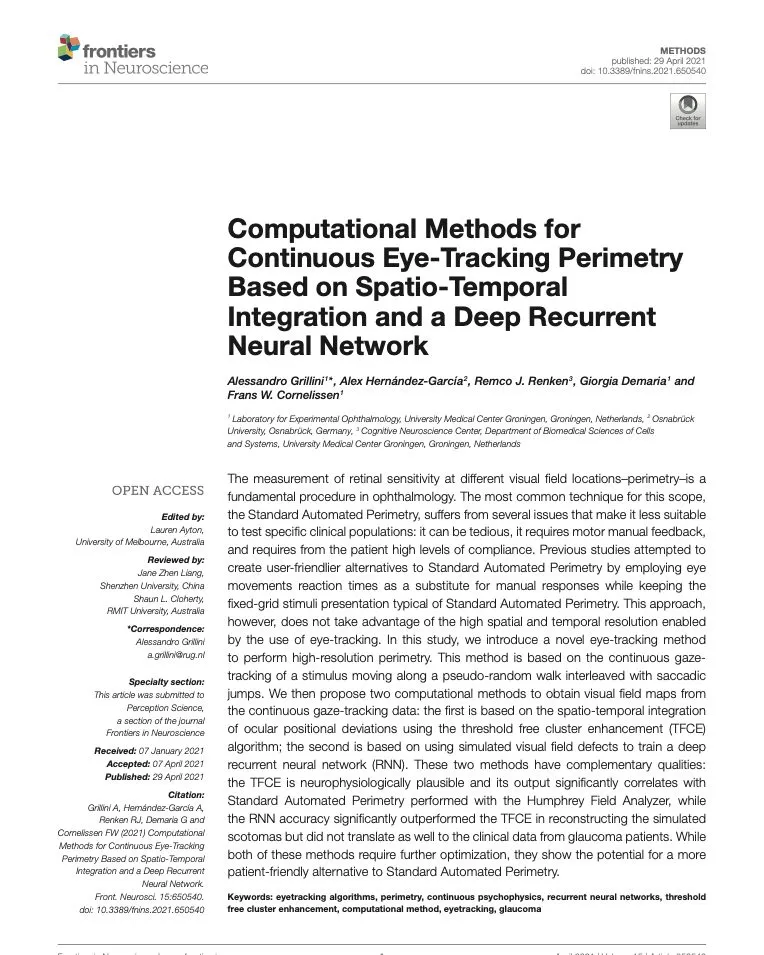
Read the paper: doi.org/10.1016/j.prdoa.2022.100170Introduces continuous eye-tracking perimetry: visual field maps reconstructed from a two-minute gaze-tracking task, whose output correlates with Humphrey perimetry in glaucoma patients.
Computational methods for continuous eye-tracking perimetry based on spatio-temporal integration and a deep recurrent neural network. Frontiers in Neuroscience, 15:650540.
Read the paper: doi.org/10.3389/fnins.2021.65054094.5% accuracy in separating patients with glaucomatous or neuro-ophthalmic visual field defects from controls, using interpretable decision trees, with normative values that held across an Indian and a Dutch cohort on different eye trackers.
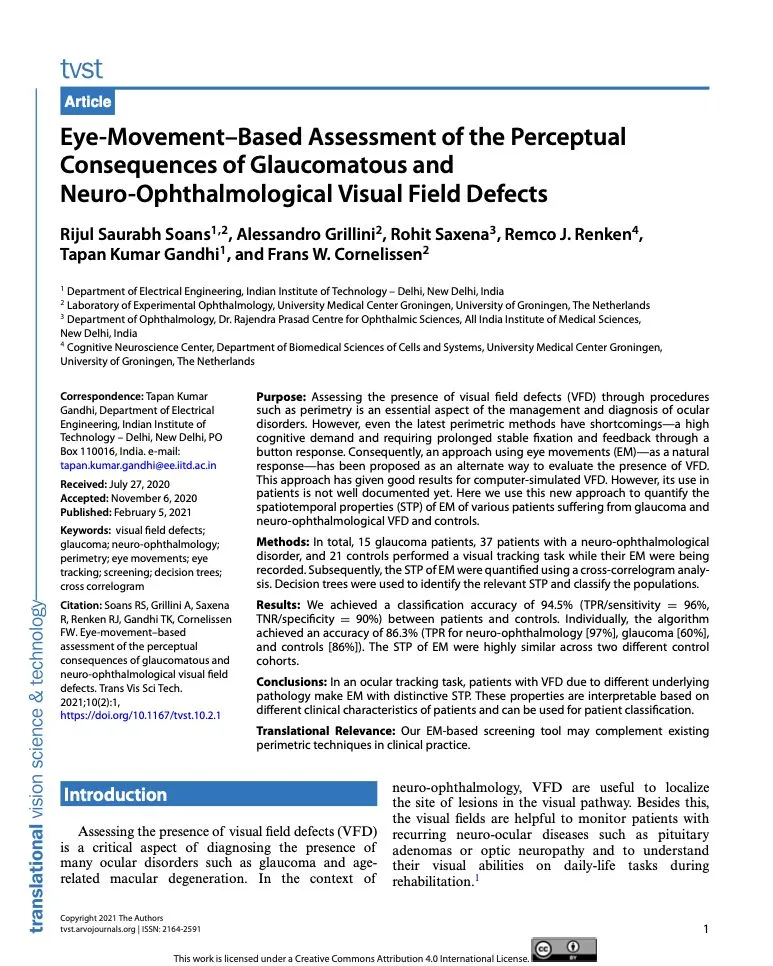
Eye-movement-based assessment of the perceptual consequences of glaucomatous and neuro-ophthalmological visual field defects. Translational Vision Science & Technology, 10(2):1.
Read the paper: doi.org/10.1167/tvst.10.2.1In multiple sclerosis and Parkinson's disease, SONDA's spatio-temporal analysis revealed oculomotor abnormalities that the conventional saccadic main sequence missed, from a few minutes of tracking instead of 20 to 25 minutes of standard protocols.
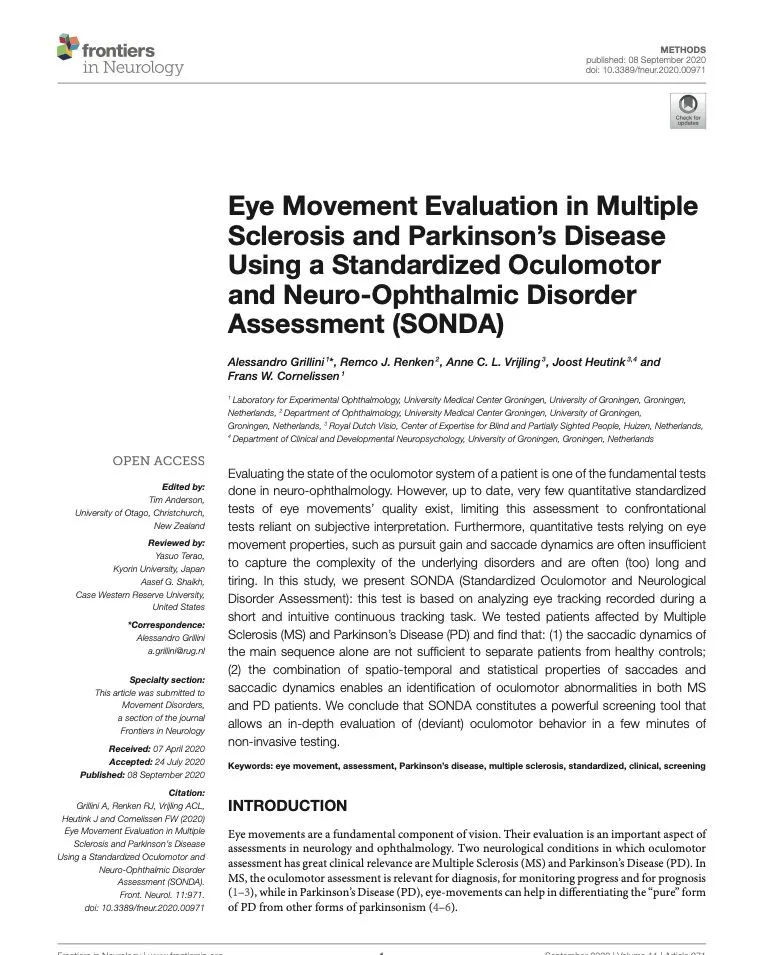
Eye movement evaluation in multiple sclerosis and Parkinson's disease using a Standardized Oculomotor and Neuro-Ophthalmic Disorder Assessment (SONDA). Frontiers in Neurology, 11:971.
Read the paper: doi.org/10.3389/fneur.2020.00971
No publications in this topic yet.
Interested in the research programme?
Tell us about your group and the question you want to answer.